

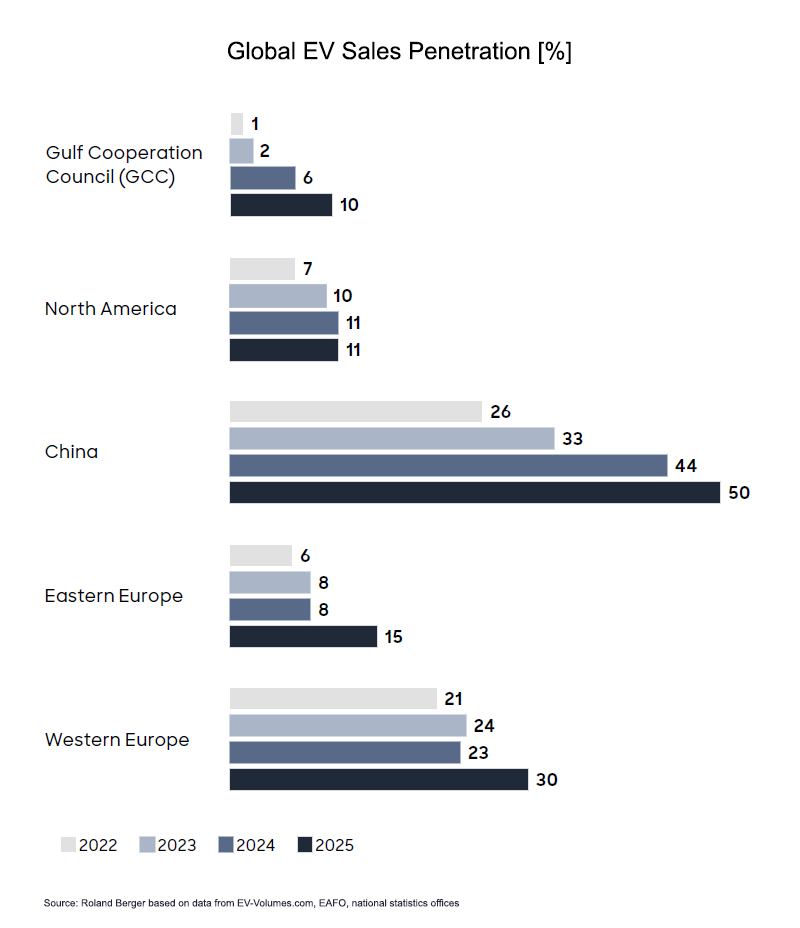
EV adoption in the Middle East is accelerating, supported by diversification agendas, expanding model availability, and steady improvements in charging infrastructure. Electric Vehicle sales in the MENA grew by around 50% in 2025, rising from 0.2 million in 2024 to 0.3 million in 2025, making it one of the fastest‑growing emerging EV regions globally. GCC markets in particular are gaining momentum: EV sales penetration increased from 6% in 2024 to 10% in 2025, reflecting rapid progress from a low base and mirroring global trends where EV interest expands beyond early adopters to mainstream, cost‑conscious buyers.
EV Adoption Trends in Major GCC Countries
The UAE remains the region’s most advanced EV ecosystem. UAE reached 9% EV sales penetration in 2025, up from 6% the year before, driven by strong BEV and PHEV uptake. While MENA’s total public charging base remains below 100,000 units, the UAE leads regional deployment and maintains one of the highest fast‑charging ratios in the Gulf. Combined with EV‑ready building regulations, government incentives, and high consumer satisfaction, this infrastructure significantly reduces range anxiety and supports continued adoption.
Saudi Arabia is emerging as the next major EV market, reaching 3% EV sales penetration in 2025 compared with 2% in 2024. National electrification targets such as Riyadh’s goal for 30% of new cars to be electric by 2030 and large‑scale charging investments, including the Public Investment Fund’s EVIQ program, are expected to accelerate adoption further.
Qatar continues to show strong consumer sentiment toward electrification, reaching 15% EV sales penetration in 2025 (7% BEV, 8% PHEV). Affordability remains a key driver, with lower running costs cited as a primary motivation consistent with global trends where pragmatic, cost‑efficient operation outweighs environmental considerations for many buyers.
EV Charging Infrastructure
Charging infrastructure in the GCC is advancing rapidly, with the UAE emerging as the region’s leader. According to the EV Charging Index 2026, GCC countries reached 10% EV sales penetration in 2025, up from 6% the previous year, reflecting accelerating adoption across the region. The UAE now operates more than 1,800 public charging points through DEWA’s EV Green Charger network, complemented by an extensive nationwide network of EV chargers, making it the most developed EV charging ecosystem in the Middle East. Dubai’s network alone grew by more than 50% between 2023 and 2025, driven by government mandates requiring EV-ready infrastructure in new buildings.
Other GCC markets are scaling rapidly as well. Saudi Arabia’s EVIQ initiative backed by the Public Investment Fund, plans to deploy 5,000 fast chargers across 1,000 locations by 2030, addressing the country’s current ratio of 30 EVs per public charge point. Qatar, meanwhile, has achieved one of the world’s highest charging‑satisfaction scores (97%). Together, these developments illustrate how GCC countries are moving from early‑stage deployment toward performance‑driven, fast‑charging‑focused networks mirroring the global shift highlighted in the EV Charging Index.